Disallowable expenses for Corporation tax
Understanding the rules around disallowable expenses for corporation tax is an important aspect of the compliant running of your company. Calculating your company’s corporation tax liability can, however, be complex as some legitimate business expenditure is not always allowable for a deduction against taxable profits.
To assist you in understanding disallowable expenses for Corporation Tax, we have compiled this guide to make it easier for you to ascertain your Corporation Tax liability. If you have any further questions regarding your company’s requirements in any aspect of accounting, please do not hesitate to get in touch with the team at Perrys Chartered Accountants. We are always happy to assist you in any way we can.
What are allowable expenses?
Allowable expenses are costs that a business can deduct from its taxable income when calculating its taxable profits and resulting corporation tax liability. As a general rule, these expenses are those which are incurred “wholly and exclusively” for the purposes of the business. Most expenses incurred by a business will therefore be allowable.
Examples of allowable expenses for corporation tax
Some examples of allowable expenses that can be deducted from profits for corporation tax purposes are as follows:
- Staff entertainment. However, this cannot be client related.
- Repairs – This includes expenses on repairing assets, such as buildings, plants, and machinery, insofar there is no major enhancement of the item.
- Bad debts – where it is doubtful that a specific customer will pay its debt to the company, these can be written off and tax relief can be obtained. Of course, if the customer does pay then the amount received will be taxable.
- Company bank loan interest – where a company uses a loan to finance its operations, this loan interest is allowable as a deduction from profits.
- Salary and wages – as well as amounts paid during the year, amounts paid after the year end but relating to the accounting period are also allowable, provided these are paid within 9 months of the year-end.
- Mileage costs – mileage incurred for business (not ordinary commuting) can be reclaimed at 45p per mile for the first 10,000 miles and 25p per mile thereafter.
This is, of course, not an exhaustive list and there are many other examples of business expenditure which are allowable for corporation tax.
What are disallowable expenses?
Disallowable expenses are expenses that cannot be deducted from a company’s profits for corporation tax purposes. This means that they will not reduce the amount of corporation tax that the company must pay, though in many cases they are still business expenses and should be included as such in the year end accounts.
Additionally, expenses which have dual purpose will not be fully allowable. For example, travel abroad which has both business and personal purposes.
Examples of disallowable expenses for corporation tax
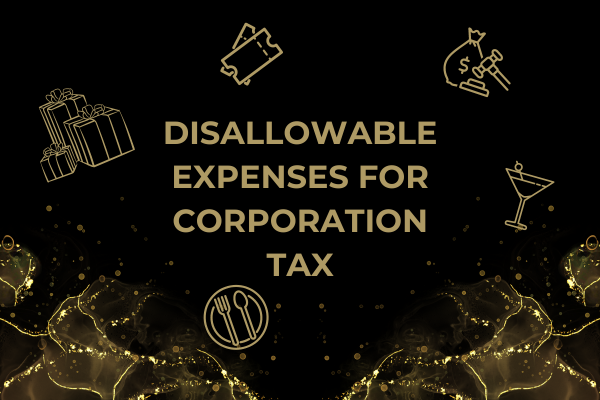
Some examples of disallowable expenses that cannot be used as a corporation tax deduction:
- Certain legal fees – legal fees for matters not relating to normal trading activities.
- Depreciation – instead of using the accounting treatment for depreciation, companies can claim capital allowances to obtain tax relief on capital expenditure
- Loan repayments – the capital element of loan repayments are not allowable, only the interest element is allowable.
- Client entertainment – treating clients to meals, drinks, events etc.
- Business gifts given to clients – though in some limited circumstances these could be treated as advertising or marketing (for example a branded pen), gifts such as a bottle of wine would not be allowable.
- Fines and penalties. For example, parking fines.
- General bad debt provisions – though specific bad debts are allowable, general bad debt provisions of a certain percentage against all customer balances are not allowable.
Allowable and disallowable expenses for sole traders
Allowable and disallowable expenses for sole traders are generally similar to those for companies subject to corporation tax. Sole traders can claim allowable expenses related to the operation of their business, such as office supplies, travel costs for business purposes, and advertising expenses in the same way as a limited company.
However, there are some differences. For example, charitable donations and pension contributions are deductible expenses for companies. However, these have a different treatment for an individual making gift aid donations or personal pension contributions.
How can a business claim allowable expenses?
Businesses claim allowable expenses by maintaining accurate records of their expenses throughout the financial year. These records should include receipts, invoices, and other supporting documentation that demonstrate the nature and purpose of each expense. At the end of the accounting period, the business must include these expenses in its year end accounts.
When completing the related corporation tax return, businesses deduct these allowable expenses from their taxable income, reducing their profits and resulting tax liability. It is crucial for businesses to ensure that adequate business records and maintained and that the expenditure claimed is compliant with tax laws and regulations to avoid potential penalties.
Contact Perrys Accountants for assistance with your company’s corporation tax
At Perrys Chartered Accountants, our expert team of corporation tax specialists are highly skilled and experienced in all aspects of corporation tax and the preparation of company accounts. We are here to ensure that you keep your corporation tax liability to a minimum, whilst making certain that all aspects of your accounting are correct and compliant. a minimum, whilst making certain that all aspects of your accounting are correct and compliant.